2022 Contract Design Challenge: Best Concept & Winning Team
Dec 09, 2022The baseline objective of contract architecture is to reconcile definitive legal rigor with seamless transactional usability. Managing this balance requires transitioning from archaic text blocks to intuitive, high-performance information systems that prioritize transparency, compress cycle times, and minimize pre-sign cognitive friction.
To stress-test these design principles in a simulated corporate environment, Legal Creatives hosts the annual Contract Design Challenge. This initiative serves as an R&D incubator where legal professionals deploy advanced usability frameworks to re-engineer standard commercial documentation into high-velocity business enablers.
The challenge lies in increasing practicality and usability when it comes to designing contracts that can be read and understood quickly while still meeting all legal requirements. Many components must be considered when creating agreements, including layout and design, language and tone of voice, as well as including necessary detail that is important for any contract.
The Architecture: Eradicating the Translation Tax
Developing an enterprise-ready document interface requires moving past purely aesthetic modifications. Participants are equipped with precise operational tools engineered to optimize document performance:
-
Cognitive Suppression Protocols: Frameworks designed to systematically eliminate dense textual noise and restructure visual information density without compromising legal precision or compliance benchmarks.
-
Comprehension Acceleration: Design methodologies engineered to maximize parsing speed and absolute accuracy for cross-functional stakeholders, particularly non-native language business operators.
-
Trust Integration Engines: Structural templates that utilize visual hierarchies, clear typography, and plain-language syntax to establish mutual transparency and prevent adversarial friction during negotiation.
Case Study: Re-Engineering the Privacy Interface
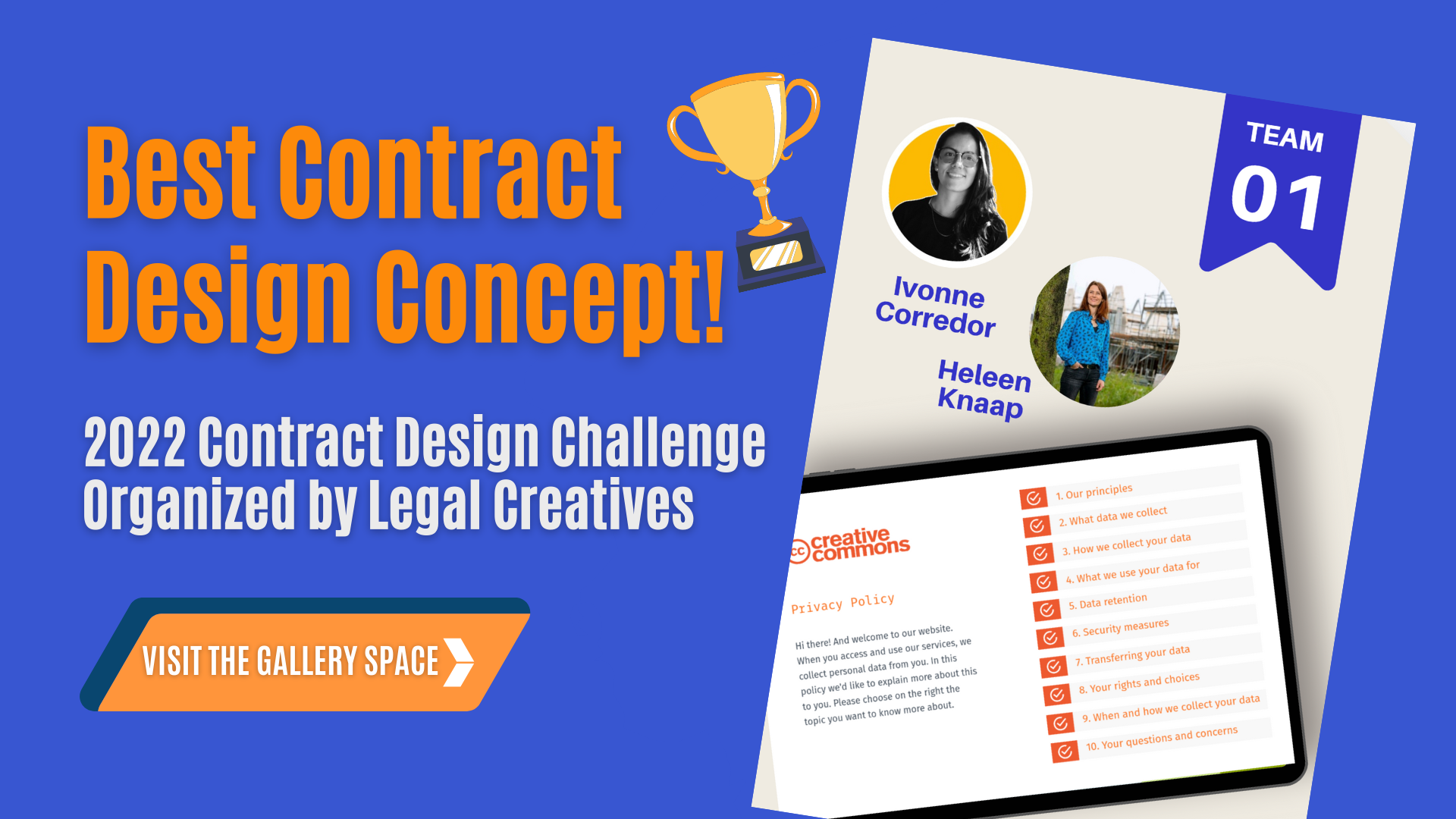
The benchmark for the "Best Contract Design Concept" was secured by the collaborative team of Heleen Knaap (Netherlands) and Ivonne Corredor (Colombia), who successfully modernized an enterprise privacy architecture.
Their execution strategy provides a definitive blueprint for structural document optimization:
User Experience Audits > Information Layering > Frictionless Interface
-
User Experience Audits: Before altering structural lines, the team executed targeted user research to map exactly how non-legal stakeholders interacted with and parsed the baseline dataset.
-
Information Layering: Rather than deploying an uninterrupted block of text, the team introduced functional data categorization. Large blocks of complex information were isolated into digestible, modular subsections supported by clear bullet matrices and explicit data tables.
-
On-Demand Navigation: The final design operates like a digital application interface. It allows enterprise readers to self-navigate the document, capturing high-level context instantly while retaining the ability to drill down into technical granular data as needed.
-
Visual Scannability: Plain-language architecture was paired with targeted semantic iconography, allowing stakeholders to identify critical regulatory subjects at a glance.
The resulting interface proved that transforming a high-density legal document into a transparent relationship tool directly enhances stakeholder alignment and protects operational speed.
The outcomes of this challenge confirm that when legal certainty is paired with deliberate operational design, the enterprise completely eliminates the overhead of the Legal Translation Tax.