Court-Tested vs. C-Suite Approved: How the ISO Plain Language Norm Changes Contract Value
Aug 12, 2026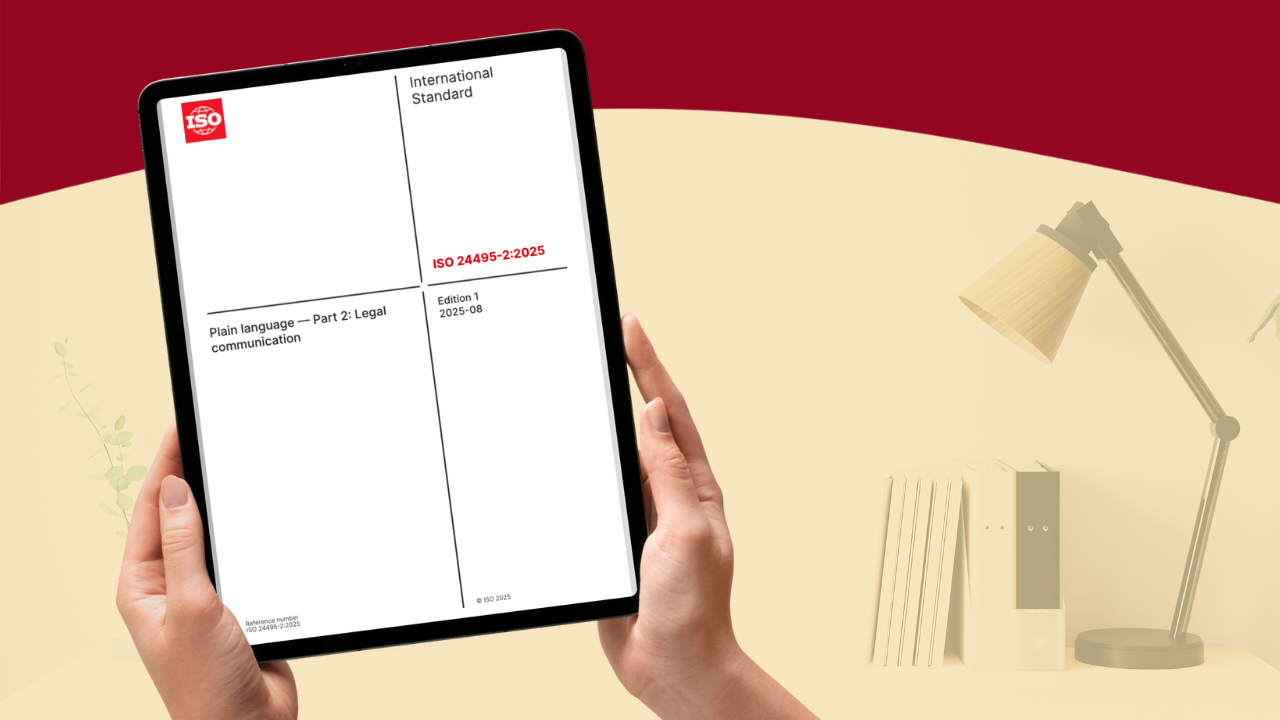
How ISO 24495-2 gives lawyers, legal ops, and legal engineers the blueprint to turn unreadable legal shields into high-velocity business drivers.
For generations, lawyers have relied on dense legalese for a reason: it feels safe. These formulas have been stress-tested in courtrooms, analyzed by legal scholars, and reinforced by decades of jurisprudence. But while legalese might build a defensive legal shield for a judge, it creates an increasingly difficult barrier between lawyers, clients, business leaders, and C-suite executives.
If you want your contracts, policies, and communications—whether written or oral—to be truly operational, you cannot rely on legalese alone. To execute at modern speed, business stakeholders need immediate clarity, not legal obscurity.
That is where the international plain language framework comes in. Developed through global consensus by legal scholars, drafting experts, and plain language practitioners across multiple jurisdictions, ISO 24495-1 and the legal-specific ISO 24495-2 provide practical guidelines, concrete techniques, and real-world examples to bridge the gap between legal precision and executive usability.
This is not just a soft linguistic preference—the ISO norm explicitly recognizes that clear legal communication is a hard business asset that drives operational ROI.
Good legal communication reduces costs, increases efficiency, and improves effectiveness and compliance.
According to ISO 24495-2, the proven business benefits include increased trust, reduced litigation, easier digitalization, and faster translation. It moves the burden of clarity off the reader and onto the author.
The AI Paradox: Generating More Legalese Faster
If you are a business lawyer, Legal Ops leader, or Legal Engineer, understanding plain language is more critical today than ever before. We are in the age of Generative AI, where algorithms can draft and review contracts at unprecedented speeds.
However, AI models are trained on historical data—meaning AI is simply producing automated shields of dense legalese faster than before. Business leaders and C-suite executives still cannot make sense of what is buried inside their contracts. The true opportunity today is using the ISO standard as an architectural framework to guide both human drafting and your enterprise AI prompts.
How ISO 24495 Breaks Down Legal Clarity
The overarching standard, ISO 24495-1, defines plain language by reader outcomes rather than strict grammar rules, establishing four governing principles:
What ISO 24495-2 Adds Specifically for Legal Communication
To ensure plain language never compromises court-tested precision, ISO 24495-2 (Legal Communication) provides dedicated tools tailored for complex legal environments:
1. Multi-Audience Information Layering: Legal documents serve judges, outside counsel, and C-suite executives. ISO 24495-2 outlines techniques like separate columns, executive summaries, and sidebars so business users scan high-level terms while litigators access technical detail.
2. Unpacking Mandatory Terms of Art: When specific statutory terms or legalese are legally unavoidable, the standard mandates adding strategic inline explanations or glossaries rather than leaving non-lawyers in the dark.
3. Systematically Eliminating Ambiguity: The standard details practical steps to isolate and eliminate lexical, syntactic, and contextual ambiguities before they lead to disputes.
4. Process & Workflow Navigation: For multi-step operational tasks (such as dispute escalation or benefit claims), the standard details how to map clear chronological steps and milestones.
5. Written & Oral Application: Beyond contracts and policies, Part 2 extends plain language guidance to oral contexts, including client consultations and court proceedings.
The Strategic Shift: Courtroom Defense vs. Executive Usability
Applying the global standard transforms legal operations from a defensive cost center into a business accelerator:
• Dense walls of text designed solely for litigation
• Alienates clients, business partners, and C-suite leaders
• AI amplifies volume without adding clarity
• Creates information bottlenecks and slows deal speed
• Legally precise, structurally layered, and visually clear
• Empowers fast C-suite decision-making and builds trust
• Guides AI tools to generate usable, structured outputs
• Reduces deal friction, legal spend, and operational risk
A Note on ISO Visual Architecture
Plain language isn't just about words. ISO 24495-2 explicitly recognizes that visuals are also essential for legal clarity:
1. Workflow & Process Mapping: The standard recommends using flowcharts for complex conditional logic and timelines for operational milestones.
2. Structural Scaffolding: It highlights side-by-side comparison tables to clearly separate rights and obligations across different parties.
3. Layout & Constraint Optimization: It provides design techniques to optimize document hierarchy and visual flow, even when working around mandatory statutory boilerplate.
Because ISO standards reflect global consensus across jurisdictions, adopting these visual and linguistic principles positions your practice at the very forefront of legal innovation.
By combining ISO plain language standards with modern AI workflows, forward-thinking legal professionals are eliminating deal friction, driving massive business value, and building deeper client trust.
Ready to Transform Your Contracts with ISO Standards?
Whether you want to build these capabilities in-house or have our expert team redesign your contract portfolio for you, we offer two direct pathways to achieve commercial clarity:
Master the Skills in the Academy
Our Contract Designer Certification Track is built directly around the ISO plain language framework. Equip your team with visual architecture, modern drafting techniques, and editable templates.
Partner with Us in the Studio
Prefer a done-for-you solution? Partner directly with our Studio team. We will audit, restructure, and redesign your complex legal templates into high-velocity, ISO-compliant instruments.
💡 Found this insightful? Share it with your legal ops & in-house network: