
Legal Ops vs. Legal Engineer: What’s the Real Difference, and How Do You Fit In?
Aug 04, 2026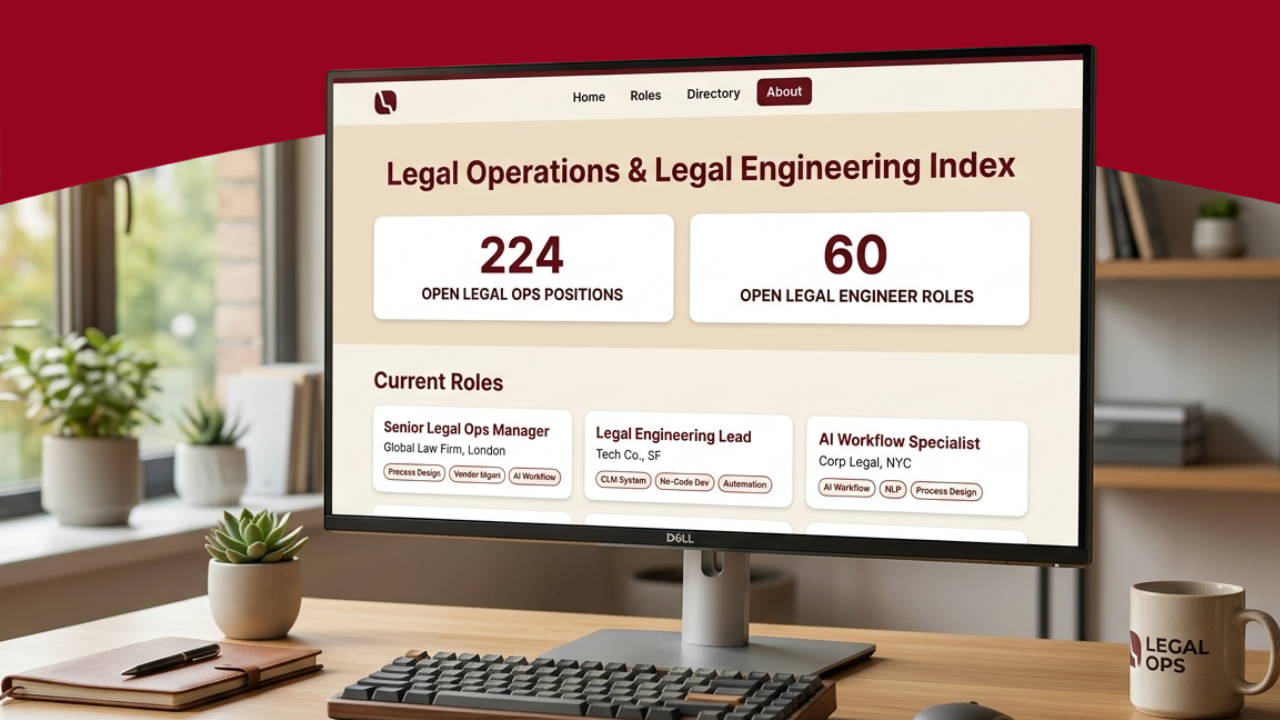
Demystifying the two fastest-growing roles in legal innovation, navigating their massive overlap, and finding your ideal career path in the AI era.
The legal landscape is experiencing its biggest structural transformation in decades. Driven by rapid enterprise AI adoption and a demand for faster delivery, non-traditional legal careers are booming. Headlines declare Legal Operations and Legal Engineering as the top growing positions across corporate legal departments and law firms globally.
Yet, for professionals looking to transition, a frustrating ambiguity remains: What actually separates a Legal Operations Manager from a Legal Engineer?
If you inspect job descriptions today, you will find continuous blur, shared responsibilities, and overlapping skill sets. Understanding how these roles operate in practice isn't just academic—it's essential for positioning your career.
Legal Ops designs the strategy.
Legal Engineering builds the engine.
While one focuses on organizational health, financial stewardship, and operational change, the other translates legal processes into structured systems, automated workflows, and practical AI execution.
What the Job Board Market Data Tells Us
To understand the current demand, we analyzed active listings on specialized legal technology job boards and corporate career platforms. Looking at live requisitions open right now (as of August 4, 2026), the numbers reveal a booming market with distinct distribution patterns:
Beyond Specialized Job Boards: While these 224 and 60 benchmark figures come directly from niche destinations like The Legal Operations Job Board and Legal Engineer Jobs, general platforms like LinkedIn reflect hundreds of active hybrid legal AI and legal ops roles globally. From top-tier law firms (e.g., Kirkland & Ellis, Latham & Watkins, Mayer Brown) and legal tech leaders (e.g., Thomson Reuters) to enterprise in-house departments, there is no shortage of demand for professionals who can connect operational strategy with technical execution.
At first glance, dozens or hundreds of open roles might sound like a focused count; until you consider that these reflect active, simultaneous hiring requisitions open on specialized job boards today. Compared to just a few years ago when Legal Engineer barely existed as an official enterprise job title, seeing these simultaneous open positions proves that organizations now have dedicated headcounts and budgets for technical legal talent.
Beyond the standalone numbers, the most striking finding is the heavy overlap. Dozens of postings titled Legal Operations Specialist explicitly require AI workflow configuration and prompt engineering, while Legal Engineer postings list process mapping, change management, and user adoption as core requirements. Alongside titles like AI Workflow Specialist and Legal Tech Enablement Manager, these roles are expanding rapidly as market demand continues to outpace certified talent.
Differences & Similitudes: A Practical Side-by-Side
Despite job titles blending in practice, comparing the core focus areas of both disciplines clarifies where the primary responsibilities land:
Process Mapping & Workflow Redesign (Both Roles): Both roles spend significant time eliminating friction. Legal Ops maps processes to reduce sales cycle bottlenecks and legal spend. Legal Engineers map processes to turn legal rules into automated, digital paths.
Requirements Gathering (Both Roles): Both sit with lawyers to understand operational friction. Legal Ops captures business requirements (budget, KPIs, vendor fit). Legal Engineers capture technical requirements (fallback clauses, conditional logic, integration rules).
Change Management & Stakeholder Alignment (Both Roles): Technology fails without adoption. Legal Ops focuses on organizational change management and department-wide buy-in. Legal Engineers focus on building backend processes that naturally align with user behavior and non-lawyer workflows.
How They Execute Core Tasks
Legal Operations Focus
- Outside counsel spend & e-billing tracking.
- Departmental budgeting & strategic roadmaps.
- Vendor evaluation & contract negotiation.
- Organization-wide change management & KPIs.
Legal Engineer Focus
- Configuring no-code/low-code workflow tools.
- Structuring contract metadata & CLM logic.
- Building custom AI agents & prompt libraries.
- Translating legal processes into backend systems.
The Big Shift: Why Most Legal Engineers Don't Code
A common misconception among lawyers looking to transition into legal engineering is: "I need to learn Python or Computer Science first."
Real-world job listings show the market has evolved. Modern enterprise legal departments and law firms increasingly rely on dedicated internal IT teams or in-house computer scientists for heavy backend coding. This leaves the Legal Engineer to operate as a high-level, strategic system architect.
Real-World Role Insights
1. The No-Code System Architect: In major corporate legal functions, Legal Engineers spend their time inside visual workflow builders mapping logic and configuring AI agents—zero traditional coding required.
2. The In-House Translation Layer: Top law firms hire practicing lawyers into AI Enablement and AI Workflow roles. Their power isn't software engineering; it's possessing practice experience so they can sit with skeptical partners, speak their language, and translate complex legal work into practical AI prompts.
3. Organizational Context Dictates Your Role: If your organization has in-house software developers, your Legal Engineer role will look almost identical to strategic Legal Ops (process mapping, requirements gathering, system design). If your company lacks tech support, you will be more hands-on with platform administration and visual build-outs.
As the market continues to shift, the line between technology and strategy will only blur further. Organizations are realizing that software alone doesn't solve legal friction—people and processes do. Because of this, the most valuable professionals in the market are no longer those who stay strictly within one title, but those who can connect operational strategy directly with modern technical tools.
How Do You Fit In? The Power of the Dual Skillset
At the end of the day, you don't need to fit neatly into a single title. What matters most is expanding your surface area of capability.
When you master the fundamentals of Legal Operations (strategy, process optimization, stakeholder alignment) alongside hands-on Legal Engineering skills (process mapping, workflow automation, AI integration), you dramatically increase your chances of finding a position that fits you.
Whether an organization is looking for a strategic Ops Manager who can talk to tech teams, an AI Workflow Specialist, or a hybrid Legal Ops Engineer, possessing a blend of both skill sets makes you exponentially more adaptable—and far more marketable—in today's AI-driven legal economy.
Gain the Skills to Lead the Market
Ready to bridge the gap between strategic process redesign and hands-on execution? Inside our online Academy, you will master how to optimize legal service delivery, process mapping, workflow redesign, and human-first AI integration.
Join the Academy & Get Certified →💡 Found this insightful? Share it with your legal ops & in-house network: