
The 4-Step Document Handoff Framework: How to Stop Legal Assets From Stalling Business Speed
Sep 30, 2026
Field-tested frameworks to eliminate friction across contracts, privacy notices, and compliance workflows.
In-house legal teams invest immense effort into drafting bulletproof agreements, privacy policies, and compliance disclosures. Every clause is carefully weighed to protect the organization from risk. Yet, despite flawless legal craftsmanship, these assets routinely encounter an operational bottleneck: the handoff.
The handoff occurs the exact moment a legal document transitions from the legal team to its end executor—whether that is a sales rep sending a contract, a customer reviewing terms, HR onboarding an employee, or a product team embedding a privacy notice.
The primary driver of legal friction in modern business isn't drafting speed—it's the friction of the manual, unoptimized document handoff.
When legal assets are handed off as static text blocks or email attachments without clear visual cues, business speed stalls. Internal teams get confused, deal velocity slows down, and support tickets spike.
To understand where documents stall and how to fix them, we analyzed field data across modern legal operations. The results led to a clear conclusion: You don't need to rewrite your legal assets from scratch to run at product speed. You need to fix the handoff.
Here is the 4-step diagnostic framework to transform your legal assets into high-velocity business tools.
Traditional vs. Modern Frictionless Handoffs
Shifting from manual, document-centric handoffs to a structured interface architecture fundamentally changes how business teams interact with legal work.
- Delivery Medium: Email attachments, static PDFs, or long text walls.
- Execution Trigger: Manual follow-ups and custom legal approvals.
- User Experience: High cognitive load; users skim or ignore terms completely.
- Operational Impact: Support ticket spikes, deal delays, and execution risk.
- Delivery Medium: Interactive UI layers, scannable cards, and embedded triggers.
- Execution Trigger: Automated decision trees and self-service routing.
- User Experience: Instant clarity, high trust, and clear next-action prompts.
- Operational Impact: Accelerated cycle times and reduced operational friction.
The 4-Step Document Handoff Framework
Interface Layering
Before sending any agreement, privacy policy, or compliance term to a non-lawyer, break the monolithic block of text into structured visual layers.
- Summary Headers: Apply scannable, plain-language section summaries at the top of dense clauses.
- Contextual Navigation: Use sticky sidebar navigation or collapsible cards for web/product interfaces so users jump directly to key obligations (e.g., Payment Terms, Data Privacy, Termination).
- Zero Text Modification: Keep 100% of your binding legal language intact beneath the visual navigation layer to maintain complete risk protection.
Trigger-Based Routing
Eliminate email ping-pong by replacing manual legal review requests with rule-based automation.
- Threshold Conditions: Pre-map standard threshold conditions (e.g., standard NDAs under $50k or standard privacy consents).
- Self-Service Intake: Configure intake forms that automatically generate pre-approved, layered assets based on user inputs.
- Escalation Triggers: Reserve human legal intervention exclusively for non-standard deviations flagged by automated decision trees.
Friction Auditing
Traditional legal metrics focus solely on time-to-signature. Modern legal operations measure time-to-comprehension.
- Stall Tracking: Track where users stall within document flows (e.g., drop-offs on specific privacy clauses or repeated redline requests on standard terms).
- Support Volume Auditing: Measure internal support ticket volume generated by teams asking for clarification on policies or terms.
- Diagnostic Iteration: Use this diagnostic data to continuously refine visual callouts and interface cues where cognitive friction is highest.
Cross-Functional Alignment
A legal asset is only as effective as the person executing it.
- Stakeholder Co-Design: Involve sales, HR, and product teams in the design process to ensure handoffs fit seamlessly into daily software tools (CRM, HRIS, or Web UI).
- Execution Playbooks: Provide internal teams with one-page "cheat sheets" or interactive decision trees that explain why specific terms exist and how to position them.
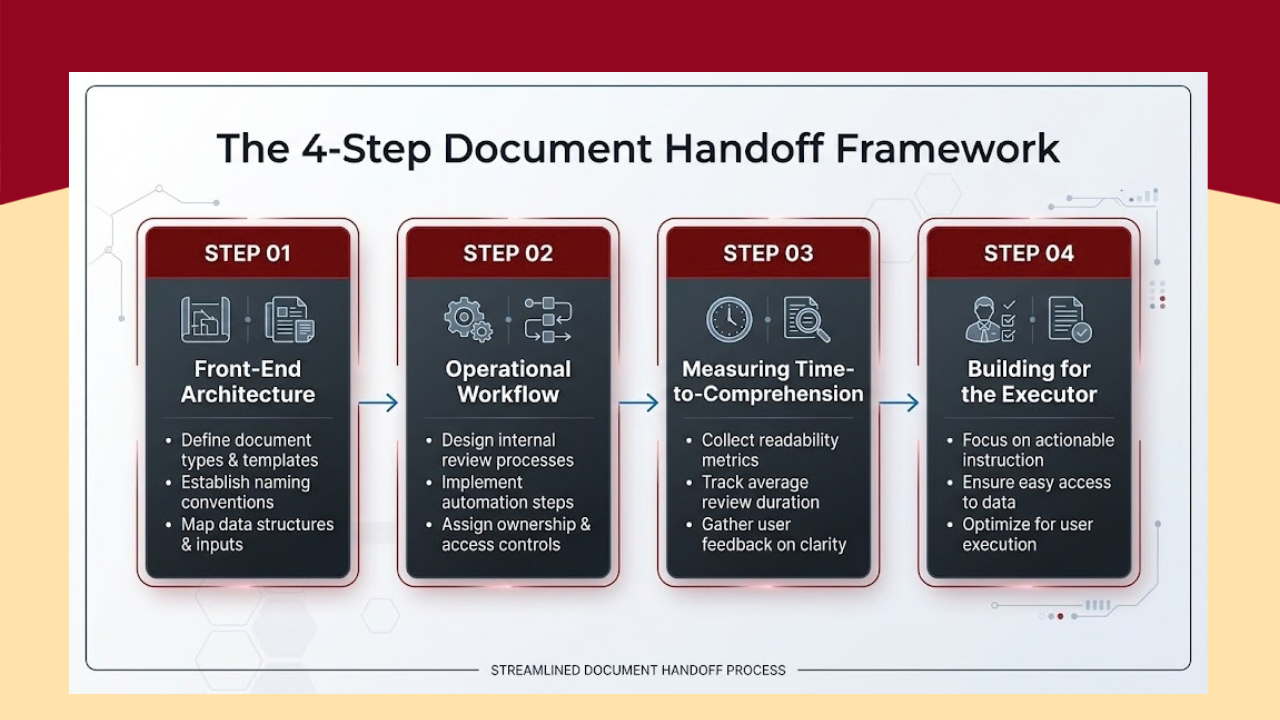
When legal teams shift focus from redrafting words to designing the handoff interface, cycle times drop, comprehension increases, and legal transforms into a high-velocity business enabler.
Modernize Your Legal Infrastructure
Whether you want to master document layering, visual design, or legal workflow automation, Legal Creatives offers dedicated pathways built for immediate operational deployment.
Looking for GC or Enterprise Partnerships? Partner with Legal Creatives Studio to modernize your legal assets.
Found this briefing insightful? Share it with your legal ops & in-house network: