
We Analyzed 300 Legal Ops & Engineering Job Postings: Here Are the 5 Core Competencies In-House Teams Are Hiring For in 2026
Sep 30, 2026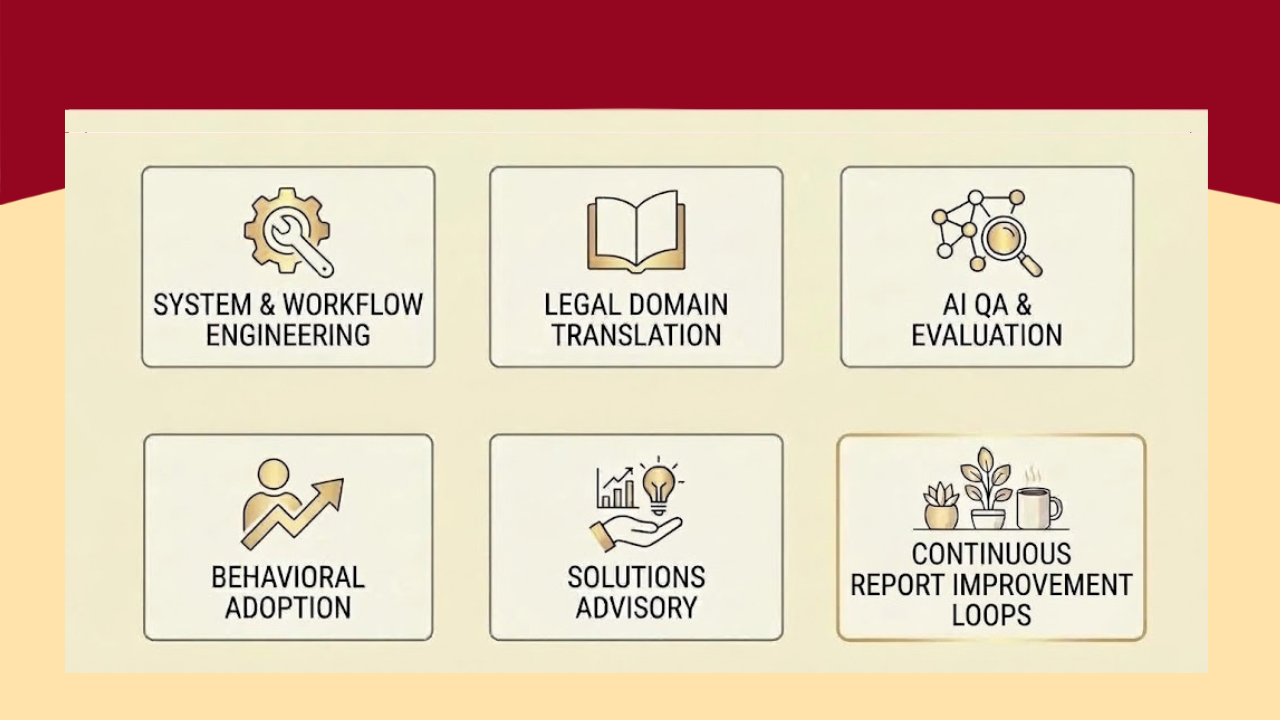
Primary research on job specs across Disney, Amazon, OpenAI, Microsoft, and top law firms reveals the death of tool administration and the rise of workflow orchestration.
The legal talent market is undergoing its most rapid structural realignment in a generation. A title shift that began as niche experimentation in progressive law firms has erupted across corporate legal departments and global enterprises: the demand for Legal Engineers, AI Enablement Managers, and Practice Automation Architects.
Yet, despite the surge in open requisitions across giants like Disney, Amazon, Microsoft, OpenAI, and Harvey, immense market confusion remains. Job titles are fragmented, expectations are blurred, and professionals are left asking: What skills actually command premium compensation in modern legal operations?
In 2026, legal departments aren't hiring for tool management—they are compensating for workflow orchestration and interface usability.
The market no longer rewards software administrators who manage vendor licenses. High-velocity legal functions are competing for hybrid professionals who translate complex legal reasoning into machine-executable architectures.
The 2026 Legal Engineering Skill Index
To decode the exact qualifications driving hiring decisions, we audited over 300 active job postings across global law firms, Big Tech legal departments, ALSPs, and legal AI startups. Below is the breakdown of core capability requirements appearing across job specifications:
Require low-code/no-code, machine-executable schemas, RAG pipelines, or API integrations.
Specify a J.D., state bar admission, or substantive legal practice background.
Mandate testing rubrics, benchmark datasets, and human-in-the-loop checks.
Comparative Role Architecture
The industry often conflates Legal Operations and Legal Engineering. While complementary, each role addresses distinct operational bottlenecks across the legal value chain:
| Role Title | Primary Focus | Key Deliverables | Primary Metric |
|---|---|---|---|
| Legal Operations Specialist | Vendor management, budget tracking, intake routing, and software stack governance. | CLM deployment, billing dashboards, intake forms, and vendor SLAs. | Cost reduction & spend variance |
| Legal Engineer / AI Engineer | System architecture, LLM agent workflows, prompt engineering, and rule-based automation. | Automated decision trees, JSON schemas, RAG evaluations, and intake bots. | Cycle-time velocity & system accuracy |
The 5 Core Competencies In Demand for 2026
System & Workflow Engineering
The era of static document assembly is over. Organizations are building interconnected automation pipelines that link intake, execution, and risk assessment into single operational flows.
- Low-Code / No-Code Orchestration: Configuring complex intake tools (Tonkean, BRYTER, Neota, Zapier) to execute multi-branch decision trees.
- LLM & RAG Architecture: Implementing prompt engineering, retrieval-augmented generation pipelines, and specialized co-pilot workflows for contract review.
- Structured Data Modeling: Decomposing subjective legal clauses into machine-executable schemas (JSON, YAML) and standard API parameters.
Legal Domain Translation
Software engineers cannot translate unwritten negotiation playbooks into software rules without losing legal precision. High-value roles require deep legal domain fluency.
- Tacit Expertise Extraction: Converting implicit attorney judgment and negotiation habits into explicit rulesets and fallbacks.
- Clause Library Mapping: Categorizing contract taxonomy, risk boundaries, and approval thresholds for automated review engines.
- Cross-Functional Subject Bridge: Serving as the bilingual link between senior practice partners/GCs and internal IT/software engineering teams.
Friction Auditing & AI Evaluation
As generative AI agents take on autonomous legal tasks, verification protocols are now mandatory across leading corporate legal setups.
- Benchmark Testing & Evaluation Rubrics: Building custom testing datasets to measure hallucination rates, recall, and precision in legal AI output.
- Human-In-The-Loop Checkpoints: Embedding mandatory risk mitigation gates where human attorneys approve high-liability deviations.
- Cycle Time & Accuracy Metrics: Tracking real-time operational metrics (time-to-comprehension, deal velocity, error rates) rather than basic usage logs.
Behavioral Adoption & Enablement
The primary reason legal technology investments fail isn't technology—it is resistance to user adoption. Modern job specs place heavy weight on change management.
- Pilot Program Leadership: Structuring iterative proof-of-concepts (POCs) with targeted practice groups or business units before full enterprise deployment.
- Enablement Playbooks & Coaching: Authoring interactive cheat-sheets, video walkthroughs, and 1-on-1 coaching models that reduce cognitive friction for end-users.
Solutions Advisory & Co-Design
Legal Engineers are increasingly embedded directly in business units and client-facing teams to co-design customized legal solutions.
- Discovery & Scoping Sessions: Conducting consultative discovery with internal stakeholders (Sales, HR, Product) to identify true execution bottlenecks.
- Voice of the Customer (VoC): Feeding real-time user feedback and edge cases back into product roadmaps and engineering backlogs.
Self-Assessment: Is Your Skill Set Ready for Modern Legal Ops & Engineering?
Evaluate your current capabilities against the 5 benchmarks modern legal departments are compensating for:
Score Check: Checked fewer than 4 boxes?
You can't achieve change acceleration (#5) without mastering workflow logic, schemas, AI evaluations, and co-design (#1–#4). If you're ready to master these exact skills with practical, hands-on frameworks, our academy is built to get you job-ready.
Master these 5 competencies in the CLOE Academy →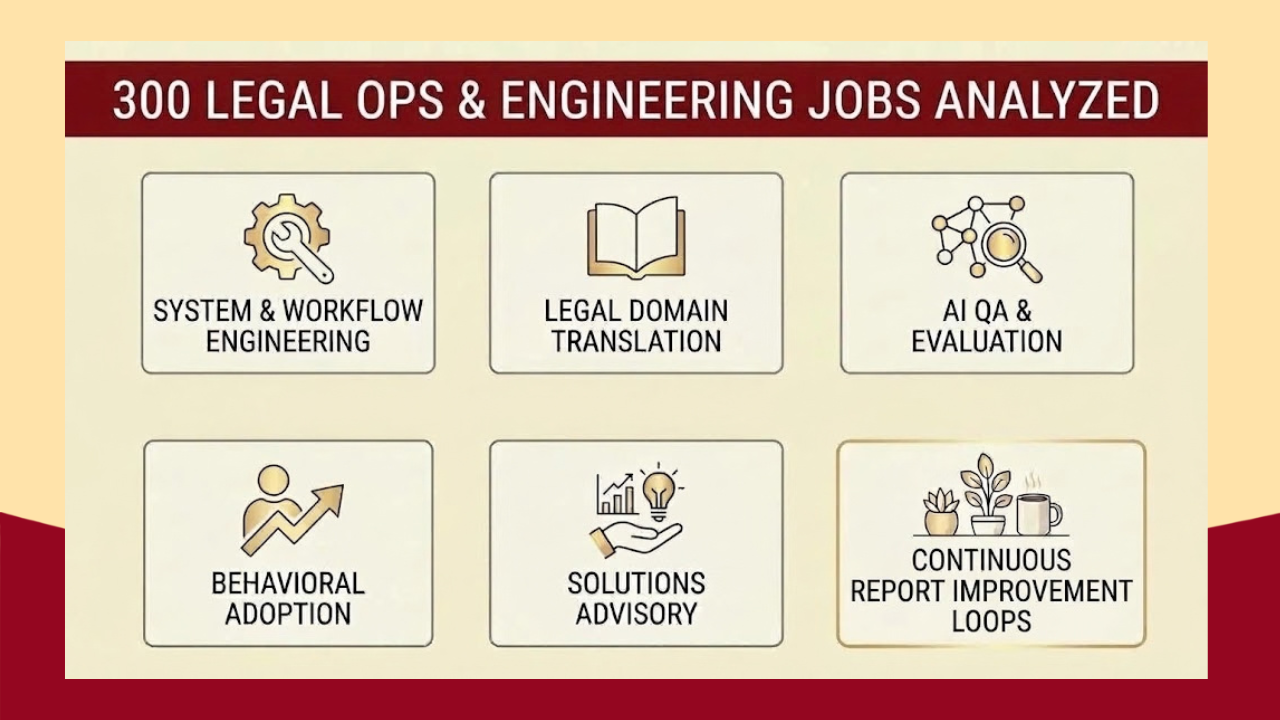
Upgrade Your Career for the New Legal Talent Market
Whether you want to master workflow engineering, Legal Creatives provides certified pathways designed for immediate industry deployment.
Looking to Upskill Your Entire Legal Team? Partner with Legal Creatives Studio to train your organization.
Found this research briefing insightful? Share it with your legal ops & tech network: