
What Big Tech Is Hiring For—and What It Means for the Future of Legal Work
Oct 08, 2026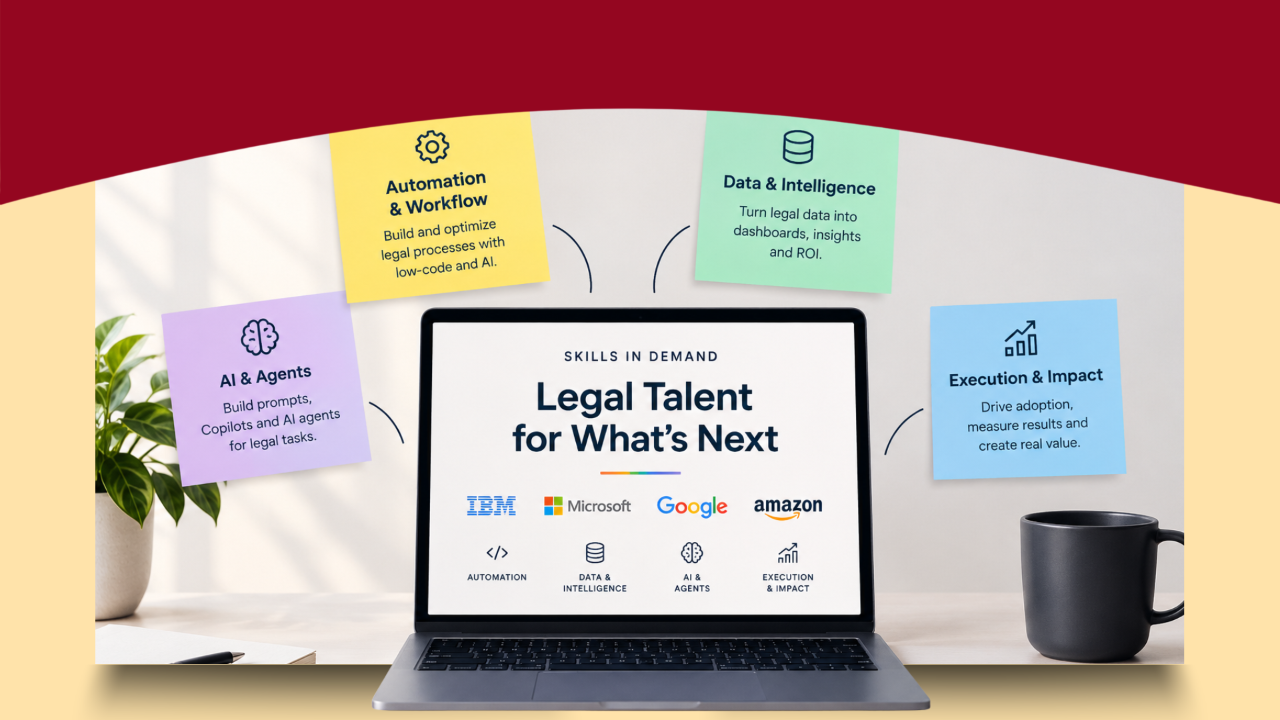
What are IBM, Microsoft, Google, and Amazon actually hiring legal professionals to do? Four emerging capabilities reveal where legal work is heading.
A fundamental shift is underway in how legal work gets done. IBM, Microsoft, Google and Amazon aren't just hiring lawyers and legal operations professionals to manage technology. Their latest roles reveal something bigger: the legal function is increasingly expected to build, automate, measure and redesign how work gets done.
While Big Tech is leading this shift, this is not an isolated phenomenon. Hundreds of open roles across corporate legal departments, law firms, and ALSPs show that the entire legal industry is seeking professionals who can bridge legal domain expertise with hands-on systems execution.
"You read a manual process, separate the genuine judgment from the scaffolding, and redesign the work so AI carries the process."
— Amazon Legal Spec
Modern legal operations is no longer about managing tools; it is about stripping away administrative scaffolding so human legal judgment can operate at maximum velocity.
The Shift: What Big Tech Is Hiring For, and What It Means for Legal Work
Analyzing current job postings highlights four distinct operational focus areas across major tech companies:
Translating complex litigation strategies into automated workflows and analytics pipelines.
Shipping real capability: building custom agents, Copilot prompts, and platform data dashboards.
Leading business process teams, tracking OKRs/SLA metrics, and eliminating operational friction in intake.
Hands-on building of low-code/no-code workflows and AI agents that measure and deliver actual time savings.
4 Insights From Big Tech Requisitions
1. The Death of Status Updates: "Builder-First" Requirements
Amazon explicitly states that their AI Program Manager is not a traditional coordination role: "You will spend the majority of your time building working AI agents and automation workflows, not writing status updates." Microsoft echoes this, calling their Legal Engineer a "role for a builder who will ship real capability rather than advise from the sidelines." The market is prioritizing hands-on execution over passive management.
2. The Bilingual Bridge: Designing "With" Lawyers, Not "For" Them
Pure software developers often struggle to understand legal nuance, while traditional lawyers may lack technical workflow skills. Microsoft specifically hires Legal Engineers who can "stay close enough to attorneys and paralegals to design with them rather than for them" and translate legal needs into clear technical requirements.
3. The "Intelligence Layer": Quantifying Adoption & ROI
IBM requires eDiscovery leads to convert case data into predictable cost models and process improvements. Microsoft requires Legal Engineers to build an "intelligence layer"—extracting platform data into standing dashboards so leadership questions regarding ROI and throughput are answered automatically.
4. Beyond Big Tech: The Industry-Wide Hiring Boom
While Big Tech sets the benchmark, hundreds of open roles across the job market reinforce that this demand extends well beyond Big Tech. Law firms like White & Case and Cooley are hiring Legal Process Engineers; companies like Disney, LEGO, and TikTok are building Legal Ops innovation teams; and startups like Harvey and Legora are hiring Legal Engineers globally.
You don't need to become a software engineer. But you increasingly need to understand how legal work can be redesigned, automated, measured and augmented by technology.
Comparative Role Architecture
Understanding how these roles differ across tech environments, corporate legal departments, and law firms helps identify where your skills add the most value:
| Sector / Role | Primary Core Objective | Key Deliverables Required | Primary Impact Metric |
|---|---|---|---|
| Big Tech Legal (Microsoft, Amazon, IBM, Google) |
Build system automation, deploy AI agents, and establish data pipelines. | Agent prompt libraries, Power BI dashboards, automated intake pipelines. | Cycle time reduction & adoption throughput |
| Corporate In-House (Disney, Sony, TikTok, LEGO) |
Align business units (Sales, HR) with legal self-service and contract workflows. | CLM configurations, self-service portals, automated approval gates. | Deal velocity & internal ticket reduction |
| Law Firms & ALSPs (White & Case, Consilio) |
Productize legal services, optimize matter delivery, and build custom client tools. | RAG evaluation rubrics, practice group AI solutions, structured data models. | Margin expansion & billable output accuracy |
Self-Assessment: Could You Pass the Modern Legal Engineering & Ops Test?
Forget the job title for a moment. These are the capabilities increasingly showing up in modern legal roles. How many can you confidently say you can do?
Ready to bridge the execution gap?
If you are looking to master these practical, hands-on capabilities, the Legal Creatives Academy offers dedicated certified pathways designed for immediate workplace application.
Master Legal Ops & Engineering in the CLOE Academy →Upgrade Your Capabilities for the New Legal Talent Market
Master the exact dual-track capability modern enterprise legal departments and law firms are hiring for in our Academy.
Looking to Upskill Your Entire Legal Team? Partner with Legal Creatives Studio to train your organization.
Found this research briefing insightful? Share it with your legal ops & tech network: