Deconstructing Trust: The Visual Proof Behind High-Performance Legal Design
Jan 28, 2026
Legal teams hear a lot about legal design.
Clearer contracts.
Simpler language.
More visual documents.
But until you see a real example, it can still feel abstract.
So here’s one.
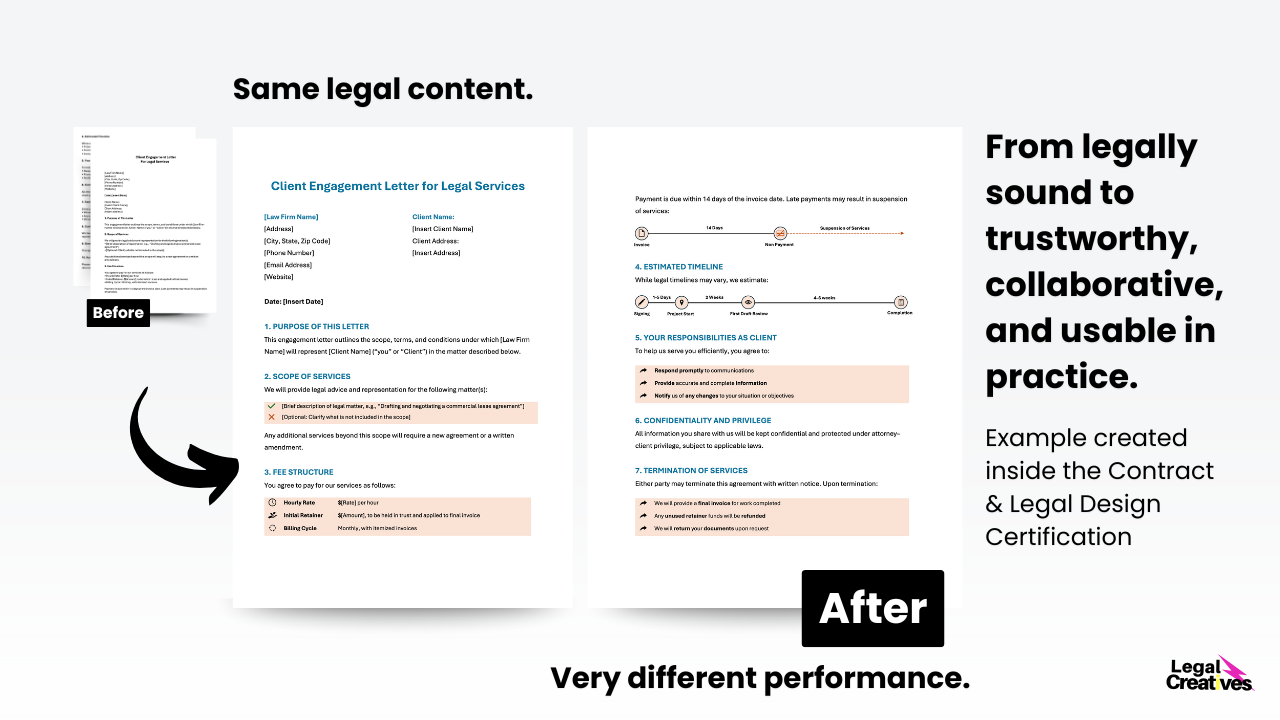
This document was created inside the Contract & Legal Design Practitioner Certification:
a client engagement letter redesigned using legal design principles, structured templates, and applied guidance from the program.
Same legal substance.
Very different performance.
The traditional version (before)
Most engagement letters follow a familiar pattern:
-
long blocks of dense text
-
minimal structure or hierarchy
-
no visual cues to guide reading
-
legal and commercial expectations mixed together
-
little sense of priority or flow
The information is technically there.
But it isn’t doing much work.
Clients skim.
Questions follow.
Misalignment appears later; when it’s most costly.
The document is legally sound, but functionally weak.
The redesigned version (after)
The redesigned engagement letter looks, and works, differently.
It is designed to be trustworthy, functionally effective, and collaborative.
Specifically, it:
-
clearly explains scope, roles, and responsibilities
-
structures information around how people actually read and decide
-
separates “what matters now” from background detail
-
uses hierarchy, tables, subtle color, and icons intentionally
-
creates transparency around expectations from the first interaction
The goal wasn’t to simplify the document.
It was to make expectations visible and actionable.
The document becomes a working tool; a not just a legal formality.
This is why legal design is not about aesthetics.
It’s about legal performance.
Why this matters beyond contracts
Although this example is a client engagement letter, the same approach applies to:
-
privacy notices and compliance documents
-
internal policies and playbooks
-
training materials
-
executive-facing presentations
-
AI-assisted legal outputs that still require human judgment
Anywhere legal information needs to be understood, trusted, and acted upon, functional effectiveness matters.
In the age of AI, this skill matters even more
AI can generate legal text quickly.
What it cannot do on its own is:
-
decide what information matters most
-
structure content around human decision-making
-
balance legal accuracy with usability
-
build trust through clarity and intention
That remains a human legal capability.
And it’s a learnable one.
This is what teams learn to do
Inside The Studio lawyers work on real documents like this; applying legal design, plain language, and visual thinking in a structured, repeatable way.
The outcome isn’t prettier documents.
It’s more trustworthy, higher-performing legal work.