
The New Architecture of Legal Delivery: Bridging Strategic Legal Judgment with Modern AI & Workflow Design
Oct 14, 2026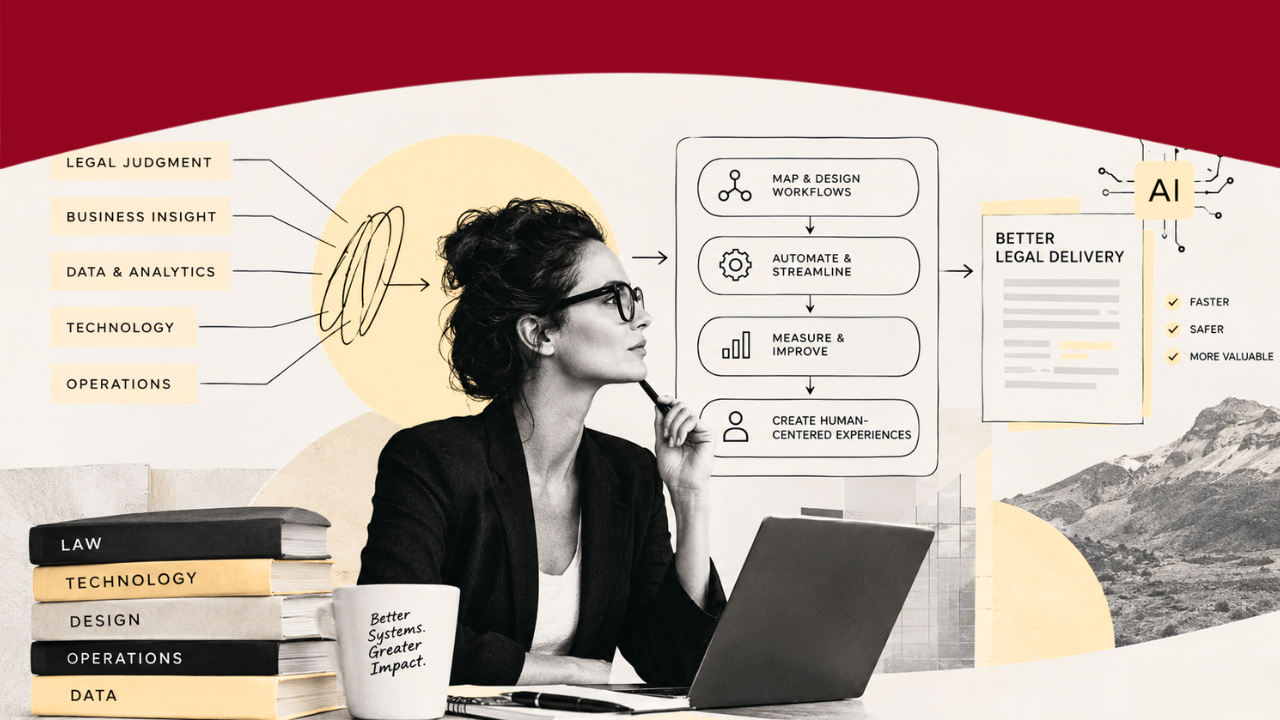
Why the future of legal expertise belongs to interdisciplinary legal minds who can translate judgment into machine logic and human-centered design.
If you’ve spent any time looking at legal job postings lately, you may have noticed something changing. The language is different.
Companies are still hiring lawyers. They still want strong legal judgment, subject-matter expertise, communication skills, and the ability to advise the business. But increasingly, they are also looking for something that would have seemed unusual in a legal job description not so long ago: the ability to build, automate, measure, and redesign how legal work gets done.
That caught our attention. So we decided to look more closely at what some of the world’s biggest technology companies are actually hiring for. We analyzed hiring signals from IBM, Microsoft, Google, and Amazon to understand what these roles tell us about the direction of legal work.
And the interesting part isn't simply that AI is appearing in legal job descriptions. It’s that the architecture of legal work itself is changing.
The opportunity isn't to become “more technical.” It's to become more capable, connecting legal judgment with systems thinking.
Companies aren't just looking for people who can use technology. They are looking for interdisciplinary professionals who can design the system around the work.
From Using Technology to Building With It
For a long time, the conversation around legal technology was largely about adoption: Which platform should we buy? How do we get lawyers to use it? How do we train everyone? That conversation is evolving.
The emerging roles we're seeing increasingly ask legal professionals to understand the underlying workflow: how information moves, where decisions happen, which steps are repetitive, where data is created, and where technology can remove friction.
This is consistent with what we found in our earlier analysis of 300 Legal Ops and Legal Engineering job postings. The technical requirements vary from role to role, but a common thread keeps appearing: employers want people who can connect legal expertise with technology, data, process improvement, and business outcomes.
And no, we don't think this means every lawyer needs to become a software engineer. Please don't panic and enroll in a six-month Python bootcamp just yet. The more important skill is being able to think in systems.
- Can you take a messy legal process and map it?
- Can you identify the key decision points?
- Can you distinguish legal judgment from administrative scaffolding?
- Can you explain the problem clearly enough for an IT or Legal Ops team to build a better solution?
The Interdisciplinary Lawyer: Learning to Translate
One of the things we find most interesting about this shift is that traditional legal expertise isn't going away. If anything, it becomes more valuable when combined with other disciplines.
Legal teams increasingly sit at the intersection of legal, operations, technology, data, product, and AI. The lawyer doesn't necessarily need to be the person building the automation. But someone needs to understand the legal logic well enough to tell the people building it what the system actually needs to do.
The titles may differ across organizations, but the broader trend is clear: legal professionals are increasingly expected to work across disciplinary boundaries rather than operating inside a purely legal silo. And that requires a different professional muscle: You have to be able to translate.
AI Doesn't Replace Judgment, It Replaces Scaffolding
This is where the discussion about AI often gets stuck. We ask whether AI will replace lawyers. A more useful question is: Which parts of legal work actually require legal judgment, and which parts are simply the scaffolding around that judgment?
Imagine a lawyer reviewing hundreds of similar requests. Some of the work involves interpretation, risk assessment, and nuanced decision-making. Some of it involves gathering information, checking standard conditions, moving data between systems, generating routine outputs, or following a predictable sequence of steps.
Those are not the same thing. If we can separate them, we can start designing better systems around the work. Some activities can be automated. Others can be augmented with AI. Some can be standardized. And some should remain firmly under human control. That is what we mean when we talk about human-first, AI-powered legal work. The objective isn't to remove the human—it's to stop wasting human expertise on work that doesn't require it.
The Metric Shift: Measuring Operational Performance
As legal becomes more operational, it becomes increasingly important to understand how the work performs:
- How long does a process take? Where does it get stuck?
- How much manual intervention does it require?
- Are people actually using the new workflow?
- Has it improved throughput or reduced cycle time? Did it create measurable value?
Those questions aren't traditionally at the center of legal education. But once legal is part of the operating system of the business, lawyers need to understand more than the law itself. They need to understand how work flows through the organization and how its impact is measured.
6 Core Capabilities for Modern Legal Delivery
That last capability matters more than it may seem. Improving the back-end of legal work is only half the equation. You can build an incredibly sophisticated workflow that produces a contract in three minutes. If the business user then spends 45 minutes trying to understand the document, you haven't created a better experience, you've just moved the friction.
Build These Capabilities in Our Final 2026 Cohorts
Our live, hands-on Academy sprints are engineered to equip you with both back-end systems orchestration and front-end contract usability.
Want to bundle both tracks? Explore the Complete Executive Pass.
Found this research briefing insightful? Share it with your legal ops & tech network: