Contracts Are Failing Their Users: What Legal Professionals Are Seeing on the Ground
Nov 14, 2024Contracts are meant to enable business. Yet for most clients, they do the opposite. When we worked on the redesign of the Contract Nerds Terms of Use, we surveyed participants from the Contract Nerds community, a global network of lawyers and contract professionals focused on improving how contracts are drafted, negotiated, and managed in practice.
The results offer a rare, data-backed snapshot of how lawyers perceive client experience, readability, and the current state of contract practices. The findings are both revealing and difficult to ignore. They confirm what we intuitively knew: contracts are failing their users at scale. Below, we unpack the key findings, what they mean in practice, and why contract and legal design is no longer optional for modern legal teams.
Key Takeaways:
-
Clients are overwhelmed, not reassured, by contracts: Length and complexity are actively undermining trust and efficiency.
-
Legalese remains a systemic problem, even as expectations for clarity, speed, and usability continue to rise.
-
Contract and legal design adoption is still low, creating a significant opportunity for teams willing to rethink how contracts are created and delivered.
The Data: What the Contract Nerds Community Told Us
Contract Nerds approached us to redesign their Terms of Use with a clear ambition: increase trust, improve clarity, and turn a traditionally overlooked legal document into a practical learning example for the contracts community. The redesign was intentionally positioned as both a real-world legal design project and an educational case study.
As part of this process, we surveyed members of the Contract Nerds community. Today, we surveyed members of the Contract Nerds community during a live webinar, gathering real-time input from legal professionals on how contracts perform in practice. The findings reinforced a clear pattern: while contracts are legally robust, they frequently fall short in meeting users’ needs for clarity, usability, and confidence.
No1. Length Is Not Neutral, It’s Overwhelming Clients
97% of respondents reported that their clients are overwhelmed by the length of contracts and legal documents. More concerning: 32% said this happens systematically, not occasionally.
This tells us two important things.
First, document length is no longer perceived as a proxy for rigor or protection. Instead, it signals cognitive burden. Long contracts slow review, delay decisions, and increase reliance on back-and-forth clarification.
Second, this is not a “difficult client” problem. It is a structural design problem. Contracts are being drafted primarily for internal comfort, not for user comprehension.
The result? Slower negotiations, more redlines, delayed revenue, and growing frustration on both sides of the table.
No2. Legalese Is Still the Primary Barrier to Understanding
96% of respondents said their clients struggle to understand complex legal language. Despite decades of discussion around plain language, legalese remains deeply embedded in contract drafting. This matters because misunderstanding is not benign.
When clients do not fully understand contractual obligations:
-
Negotiations take longer
-
Implementation suffers
-
Compliance risk increases
-
Trust erodes
From an economic perspective, complexity creates friction at every stage of the contract lifecycle. From a strategic perspective, it positions legal as a bottleneck rather than an enabler.
Contract and legal design addresses this directly, not by “dumbing down” legal content, but by making it usable through clear language, structured information, and thoughtful presentation.
No3. Nearly Half of Lawyers Haven’t Used Legal Design at All
Only 17% of practitioners use visuals in their daily work to address these challenges. Furthermore, 58 percent report never using the contract and legal design, and 25 percent use it only occasionally, underscoring a clear and untapped opportunity.
This gap is significant. It means that while client expectations are evolving rapidly, many legal teams are still operating with drafting methods developed decades ago, methods that were never designed for today’s pace, scale, or complexity of business.
At the same time, this presents a clear opportunity. Legal design is not saturated. Teams that adopt it early gain:
-
Faster contract cycles
-
Better stakeholder alignment
-
Higher client satisfaction
-
A measurable competitive advantage
What Changes When Legal Design Is Applied In Practice, Not Theory
Contract and legal design shifts the focus from what is written to how it works for the user.
It looks at:
-
Structure and hierarchy
-
Navigation and information layering
-
Language clarity
-
Visual cues and formatting
-
The end-to-end contract experience
In practice, this comes down to mastering a small but powerful set of techniques that any legal team can apply. This approach is particularly powerful because it improves outcomes without increasing legal risk. In many cases, it reduces risk by making obligations clearer and more actionable. Importantly, this approach is not experimental, enforceability of visuals in contracts is increasingly well documented, provided text and design work together intentionally.
Redesigning the Contract Nerds Terms of Use
To move from theory to practice, we applied legal design principles to the Contract Nerds Terms of Use. The objective was to create a document that remains legally robust while being transparent, usable, and aligned with the platform’s values. The redesign also aligned closely with emerging international standards, including the ISO guidance on Plain Legal Language that informed how we made Contract Nerds Terms of use ISO-compliant ahead of time.
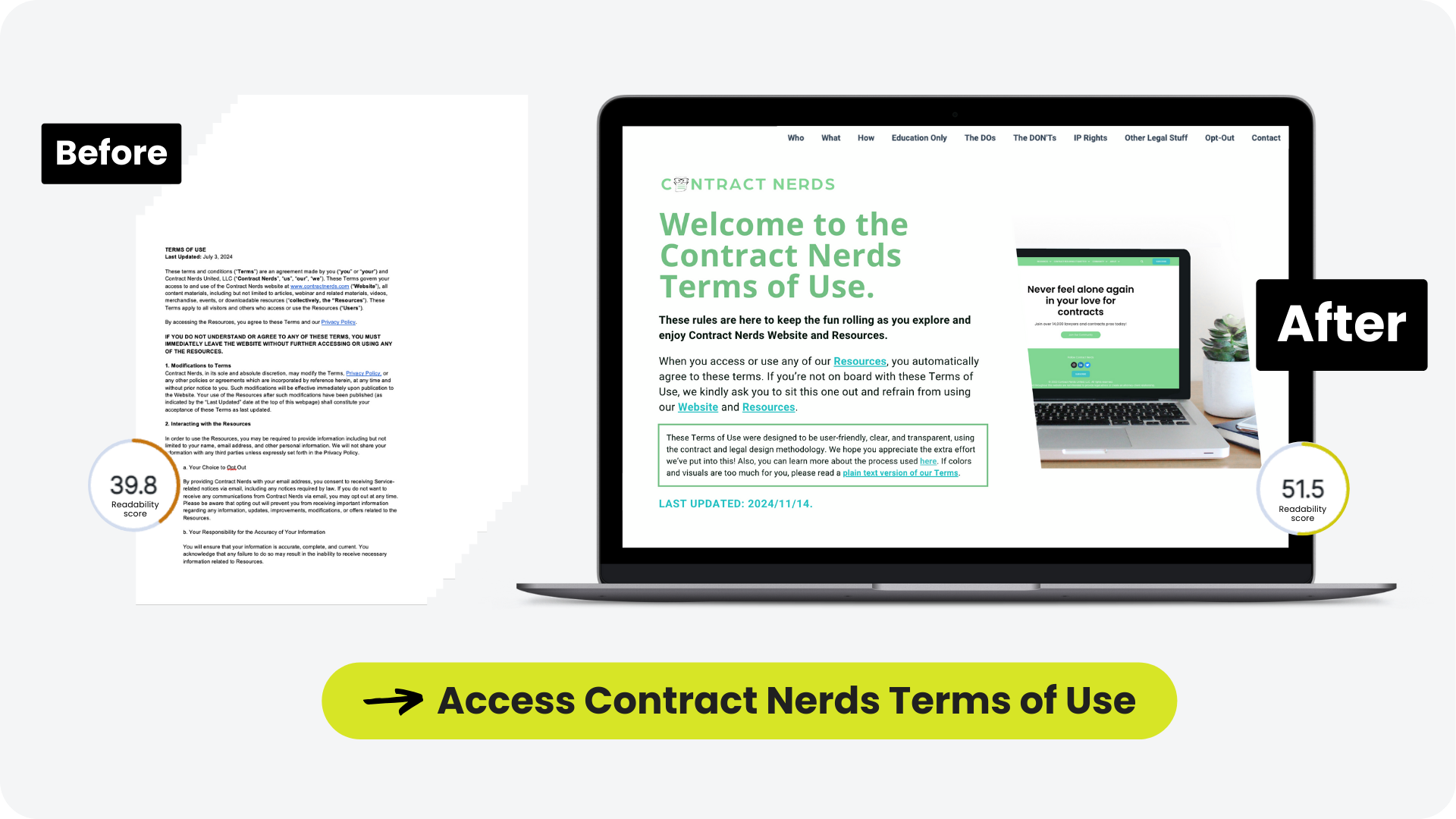
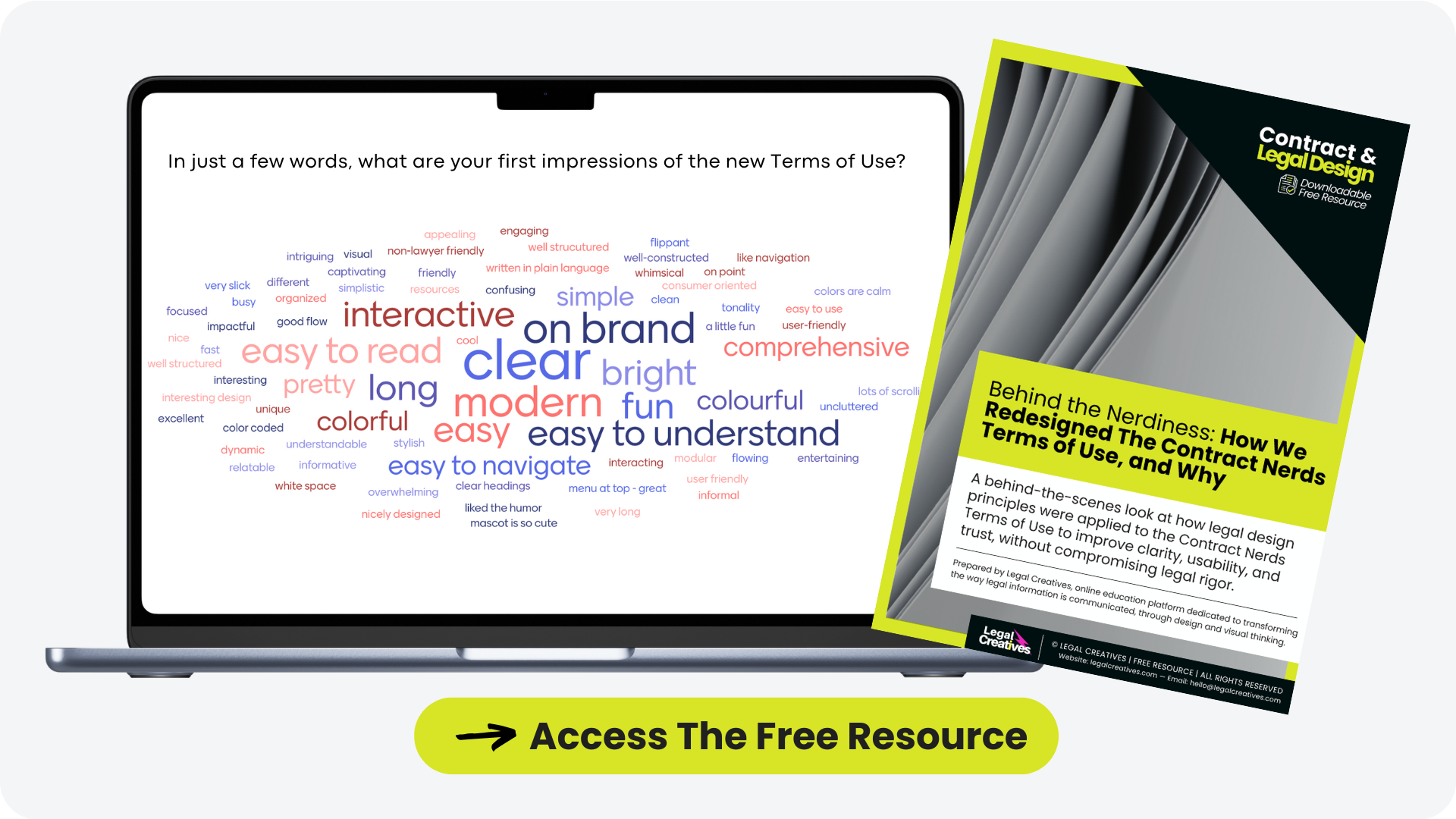
We applied our five-step contract design process, focusing on clarity, structure, navigation, and consistency. The results speak for themselves. Post-redesign feedback showed that users found the document:
-
Clear in its language
-
Fair and balanced in tone
-
Easy to use and to navigate
-
Aligned with the Contract Nerds brand
Most importantly, 77% of respondents said this clearer and more transparent presentation helps build better relationships between users and Contract Nerds. This is a critical insight. Contracts are not just legal safeguards, they are relationship documents. How they are designed directly affects trust.
👉 Download the Free resource: Behind the Nerdiness - How We Redesigned the Contract Nerds Terms of Use and Why. A behind-the-scenes look at how legal design improves clarity, usability, and trust without compromising legal rigor.
Why Technology Alone Won’t Fix Contracts
Many teams turn to AI as a solution to contracting inefficiencies. While AI can accelerate drafting, it often reproduces legalese at scale, faster, but not better.
Without addressing readability and usability:
-
Negotiation cycles remain slow
-
Contracts remain misunderstood
-
Compliance remains inconsistent
-
Trust continues to erode
Unreadable legal text carries real economic costs: delayed revenue, increased disputes, poor implementation of obligations, and diminished confidence in legal teams. Contract and legal design tackles the root cause, not just the symptoms.
AI can accelerate drafting, but without usability principles it often reproduces legalese at scale, a challenge we explore in depth through real-world experimentation with AI and legal design.
Turning Insight Into Impact: What Actually Moves the Needle
The data from the Contract Nerds community confirms a clear reality: Clients expect clarity, usability, and transparency, and contracts are not meeting that expectation. Contract and legal design provides a tested, practical methodology to close this gap. It helps legal teams move from reactive drafting to intentional design, transforming contracts into tools that support business rather than slow it down.
Turning these insights into consistent outcomes requires capability, not just intention. If these findings resonate, the next step is practice. In our Contract & Legal Design Certification, legal professionals learn how to:
-
Redesign contracts for clarity and speed
-
Reduce negotiation friction
-
Improve adoption and compliance
-
Quantify the ROI of better contracts
-
Apply contract and legal design systematically across their work
This is not about aesthetics. It is about performance. Clarity accelerates decisions. Usability reduces risk. Better contracts build better relationships. This is why we’ve seen growing interest in redesigning terms of use in the Tech space but also commercial agreements in various industries, which consistently show how clarity at the drafting stage accelerates execution later. And the data shows: the opportunity is too big to ignore.